
Locate Belmont City Directory Collections
Belmont’s historical directory record is a shelf of regional runs and companion collections, not one uninterrupted town publication. The Massachusetts State Library year inventory has the compact year list, and its asterisks belong with the years rather than being filled in by assumption. The earliest combined titles place Belmont beside Somerville or Arlington. Later editions may use Arlington and Belmont in the title even when the volume contains a distinct Belmont section. Check the title page and the city section before treating a regional volume as a Belmont-only book.
| Collection | Years | Where held | Access |
|---|---|---|---|
| Regional Somerville, Arlington, and Belmont directories | 1869-1872, including a digitized 1873 volume | State Library, Google Books, and regional repositories | Online scan where available; verify each city section on the image |
| Belmont city and town directory inventory | 1890; 1896-1898; selected years from 1900 through 1969 | Massachusetts State Library, BPL, NARA, and regional libraries | Printed holdings and digitized copies vary by edition |
| NARA-listed Belmont runs | 1927, 1929, 1932, and 1934 | National Archives city-directory holdings | Holdings reference for locating a particular printed run |
| Belmont resident lists | 1911-2009, with missing years | Internet Archive, Town Clerk, and Belmont Public Library | Digitized access, appointment, or staff assistance for fragile years |
These dates have gaps. No verified continuous final year for a Belmont-specific printed series was located. For later decades, the library’s newspapers and resident lists are stronger starting points than a presumed modern printed volume. The collection table is therefore a locator, not a promise of annual coverage.
Find Belmont City Directory Years
The earliest known Belmont directory trail is regional. Dudley & Greenough issued the Somerville, Arlington and Belmont Directory for 1869-70, followed by Greenough, Jones & Co. for 1871-72. The 1873 regional volume remains useful because its contents identify a Belmont Directory section, Belmont streets, a business directory, churches, the fire department, schools, railroad stations, and town officers. Later publishers documented in the regional history include Tribune Publishing, Edward A. Jones, Boston Suburban Book Co., and Union or Lothrop editions.
The digitized 1873 Somerville, Arlington and Belmont directory provides a direct example of the regional format that researchers should inspect as a page image.
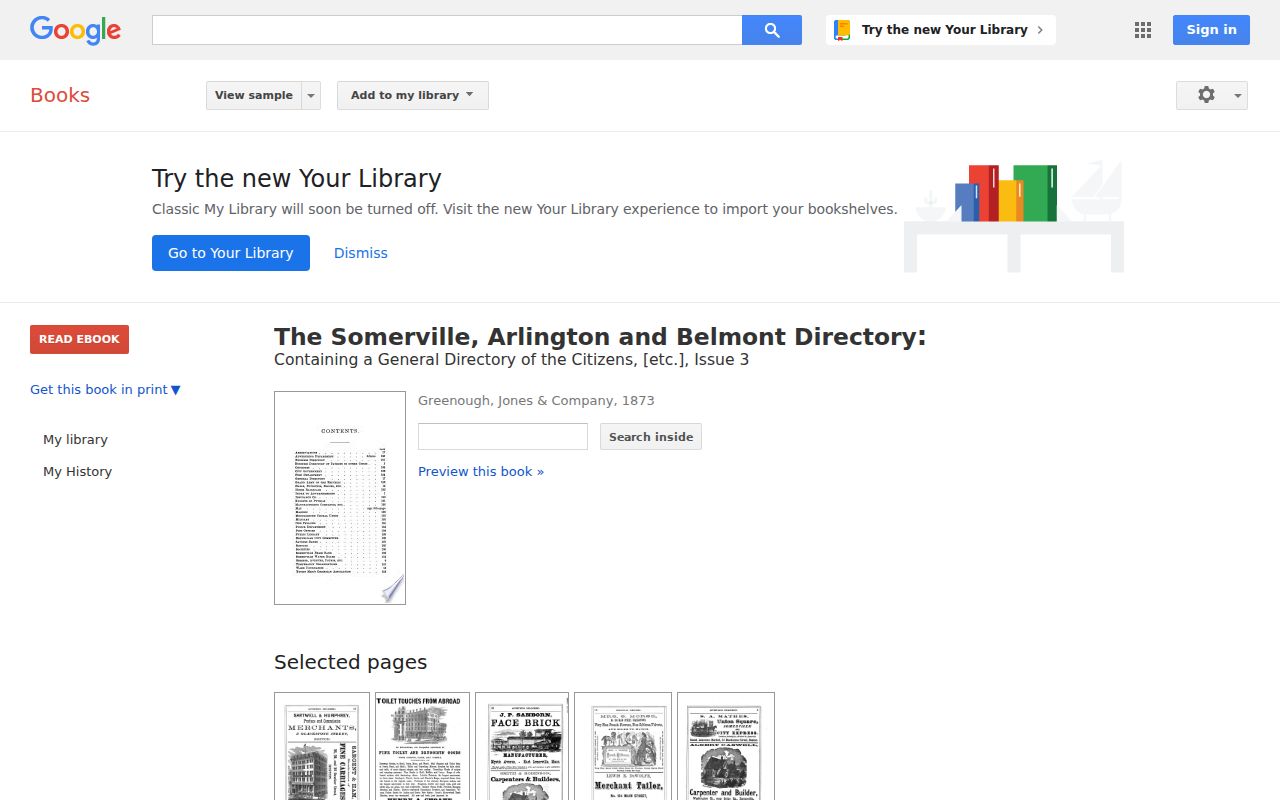
The scan is a useful place to learn the volume’s structure, but OCR can misread names. Verify a spelling from the page image before adding it to a family timeline.
From 1894 onward, the regional guide identifies separate street and house lists. That shift created a reverse-directory method: start with a street and number, then read the occupant entry. It is powerful for an address question, but it still records a printed moment in time rather than title or present residence.
Use Belmont Underwood History Room
Belmont Public Library’s Underwood Local History Room is the practical center for city-directory research that needs more than a web scan. Its local-history resources include Belmont books, annual reports, resident lists, Belmont High School yearbooks, local-author material, Jay Benton’s illustrated diaries, newspapers, obituary tools, cemetery information, and oral histories. The reference and local-history contact listed in the research is 617-993-2870. Ask staff for the exact run or companion source needed rather than assuming a modern database contains every printed year.
The Underwood Local History Room resource page is the official starting point for those library collections.
The library joins directory entries to resident lists, newspaper runs, and yearbooks, which helps test a name across sources with different dates.
Resident lists are especially useful where a city-directory year is absent. They run from 1911 to 2009 but have missing or fragile years, sometimes requiring an appointment through the Town Clerk residency resource or at the library. Treat them as annual resident evidence, not as a substitute for a deed or a complete explanation of a household.
Search Belmont City Directory Companions
The Belmont Historical Society’s Claflin Room is a companion to the library, particularly when an address needs maps, photographs, newspaper material, archives, or local context. Its collecting policy emphasizes Belmont connection and provenance. The holdings include books, newspapers and archives, ephemera, maps and atlases, photographs, audio and video, textiles, artifacts, and Wellington Station material. Those collections can clarify a street label, building name, or local event that does not appear in a printed entry.
The Belmont Historical Society collections show the breadth of material available beside the printed directory shelf.
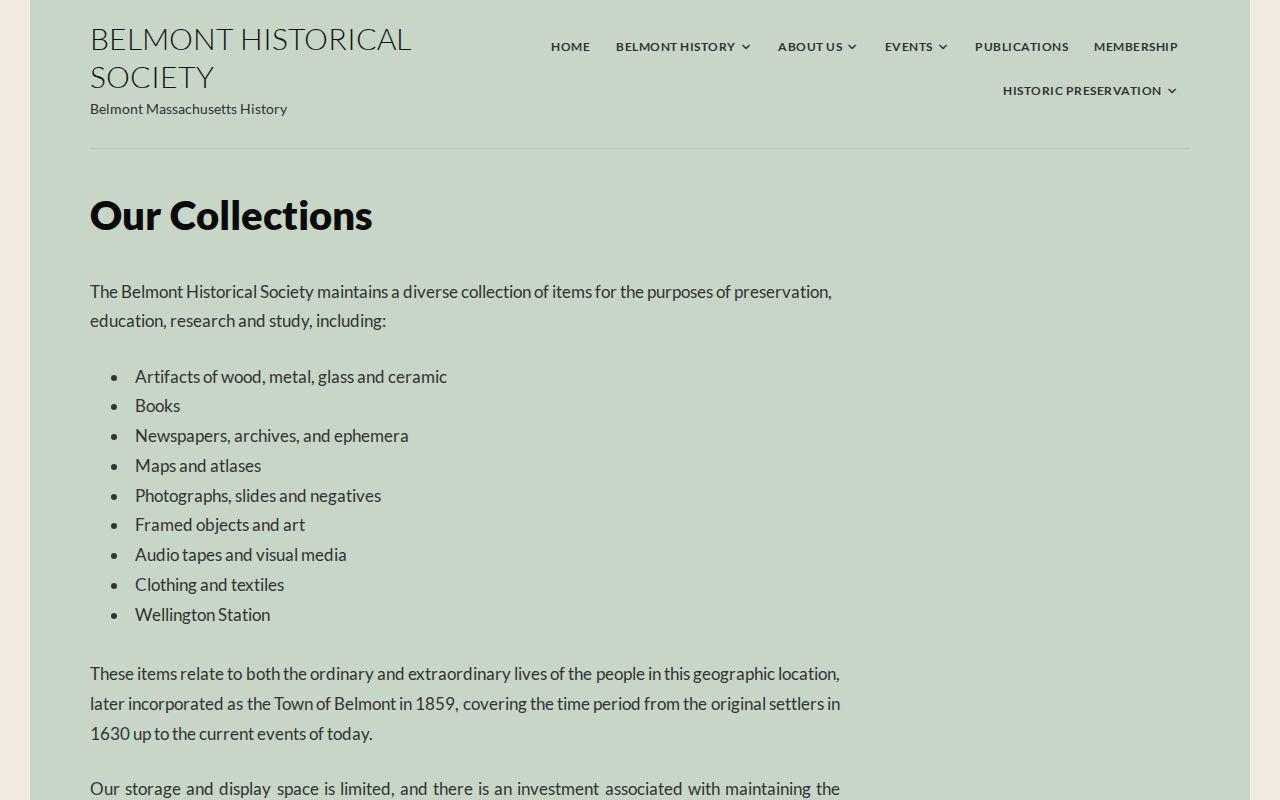
Collection items are evidence of local context, not a general personal-file service. Bring the directory year, street, name variants, and a narrow question to make a staff request useful.
Belmont High yearbooks, mostly available for 1922-2016, and the Belmont Story Project are also useful companions. A yearbook can help confirm a school-year association, while an oral history can supply a lead about a former address or organization. Neither replaces a dated directory image or an official record.
Read a Belmont City Directory Entry
A regional Belmont entry often combines a surname and given name with an occupation or business, an employer, firm, or relationship, and a home address. Read the abbreviation key before reading the entry as plain prose. In the 1869 scan, h. means house or home, boards identifies a boarder, n. means near, and adv’t identifies an advertisement. Widow notations can add a relationship clue. Those labels are clues from that edition, not proof of every person at an address.
| Name | Surname and given name, often with initials that require comparison to other dated sources. |
|---|---|
| Work or business line | An occupation, business, firm, or relationship as printed in that volume. |
| Address | Home-address shorthand, sometimes supplemented by a street or house list in a later volume. |
| Relationship clue | Boarder and widow notation can guide a later newspaper, census, or obituary search. |
| Place wording | Station districts, squares, or hill names may be historical locality labels rather than modern mailing forms. |
- Criss-cross section
- The street-order portion of a later directory. Start with an address there, then locate the name entry for its fuller text.
- Householder index
- An index organized around a household address or named householder, which should be read with its edition date.
- Abbreviation key
- The printed guide to shorthand such as h. and boards. Photograph it with the relevant entry.
Note: Save the title page, page number, and abbreviation key with any extracted entry so another researcher can recheck it.
Track Belmont City Directory Newspapers
Newspapers can fill the years between printed directories and explain a name change, move, death, club reference, or business notice. Belmont Courier runs from 1889, Bulletin from 1890, Tribune from 1902, Patriot in 1918, Citizen from 1919, Herald from 1945, and Citizen Herald from 1988 in the documented holdings. Historical newspapers from 1889 through 2015 are digitized through the library’s Digital Reel/BMI route, while Citizen Herald microfilm continues through 2022.
The Herald obituary index has a useful Belmont-specific feature: separate “Known as” and “Former/Maiden” PDFs. Search both forms of a name, then read the full notice in the digitized paper or microfilm. The index covers Jan. 1, 1945 through Apr. 1, 1988; it is a pointer to the notice, not the full obituary text. Belmont Voice is linked by the library for Jan. 2024 to current local reporting.
A printed directory entry and a newspaper notice should be recorded separately, even when they appear to describe the same person. One is a publisher’s listing and the other is a dated notice with its own wording and context.
Trace Belmont City Directory Families
Follow a person across directory years by starting with the exact spelling and address in one edition. Move one edition at a time, and make a short table of address, printed work line, relationship notation, and source page. Then compare the address with the matching resident list and the closest federal census. A census captures a household on one enumeration date; a directory can show an annual listing, a work address, or a boarder. They should be read together rather than collapsed into one record.
- Locate the earliest credible name-and-address entry and save the title, year, and page image.
- Check the next available Belmont or regional edition, noting an address change, abbreviation, or name variation exactly as printed.
- Use the street or criss-cross list when available to connect the address back to the surname entry.
- Pair the sequence with Belmont resident lists and the relevant federal census year to test the household context.
- Use the obituary index, newspaper, deed, or probate record to resolve a disappearance from the printed directory.
A disappearance can mean a move, death, changed listing practice, or a missing edition. A modern name check may help distinguish a current record from historical evidence, but it should use the separate Belmont resident lookup workflow rather than treating a directory entry as present-day confirmation.
Preserve Belmont City Directory Clues
Belmont’s record history is hybrid by design. The Town Clerk has held original vital records since the town’s 1859 incorporation, and a Community Preservation Act project begun in FY2013 continues conservation and digitization of those originals. The FY2025 Community Preservation Committee report documents the project’s ongoing work. That preservation story is a useful warning against treating any web index, including a directory scan, as identical to the archival original.
Directory research benefits from the same approach. Keep the scan, the collection name, date, page, and any OCR uncertainty. If a copy lacks a clear image, ask the library, State Library, or Historical Society for the physical or alternate digital source. The surviving record may be a book, microfilm reel, newspaper page, resident-list PDF, or archival item, and each format can reveal details the other misses.
Date Belmont City Directory Evidence
Belmont’s historical sources provide a timeline for choosing a directory edition that fits an address question. Regional publishing begins well before the town’s later resident-list period, and newspapers bridge much of the twentieth century. The sequence below is a way to choose a source window, not an assertion that every annual volume survives.
- 1869-1872: Regional Somerville, Arlington, and Belmont directory titles document early Belmont sections.
- 1873: A digitized Greenough, Jones & Co. volume includes Belmont directory and street material.
- 1894 onward: Identified regional runs add separate street or house lists for reverse-directory work.
- 1911-2009: Belmont resident lists provide annual evidence with documented gaps.
- 1889-2022: Newspaper digitization and microfilm cover multiple Belmont titles, with Citizen Herald microfilm continuing through 2022.
The Fitchburg Railroad’s 1843 arrival shaped Belmont Center and Waverley as local hubs, so nineteenth-century entries may use station districts, squares, or hill areas rather than a modern neighborhood name. Match those place terms to the year of the source before rejecting an otherwise plausible address.
Keep Belmont City Directory Gaps Visible
Digitized does not mean complete. The State Library list includes selected years and printed asterisks. The resident lists have missing years. The research did not locate a continuous final year for a Belmont-specific directory series, and no clean image-level transcription of one named Belmont entry was retained from the early scan. Those are reasons to state the gap and look for the next documented source, not to fill missing years with a generic claim.
For a nineteenth-century parcel question, pair the directory with Middlesex South deed books and historical maps. For an address around 1905 to 1949, documented Sanborn sheets can help date a footprint or use. For a twentieth-century person question, compare resident lists, newspapers, yearbooks, census schedules, and the obituary index. Careful cross-record work preserves the difference between a person listed at an address, an owner in a title record, and a name appearing in a local notice.