
Trace a Belmont Street by Address
A Belmont street search works best as a record trail, not as a single name search. Begin with the situs, meaning the physical parcel location, in the assessor database. That record can identify the tax-record owner, an MBLU or account identifier, and a book and page for a recorded sale. Next, compare adjacent addresses in the annual assessment reports or the municipal map. The deed index then explains title, while a historical directory or resident list can supply dated evidence that someone was listed there. Each source has a different purpose and date.
The state voter-status form is not a way to browse an entire Belmont street. It checks an individual registration match only when the required identifying information is known. A public local voter-list request goes through the Town Clerk and is subject to protected-voter rules. That distinction matters when moving from a public ownership record to a carefully limited, lawful address inquiry.
- Search the address in the Belmont Real Estate Database and note the owner name, MBLU or account, and deed book/page shown on the card.
- Open the address-sorted annual assessment reports to read nearby parcel rows in street order.
- Use Belmont GIS for parcel context, then return to the parcel card rather than relying on a map label alone.
- Search the book/page, parties, property, or recorded date at the Middlesex South Registry and preserve the legal description with the result.
- For an older address, consult the library and historical collections for a reverse street list, resident list, newspaper, or regional directory before treating a current parcel record as historical proof.
Note: Keep the search date with every result because assessment, title, registration, and directory evidence are maintained on different schedules.
Read Belmont Street Directory Parcel Cards
The Vision parcel card is the most useful first record for a Belmont street directory search. It is a current assessment snapshot, not a household list. Research on the public card found location, owner and co-owner fields, a mailing address, MBLU, account, land and building detail, values, sale history, and a linked book/page reference. A trust or co-owner can appear in the owner area. Preserve names as written because the same property may be indexed under an entity rather than an individual.
The sample Belmont Vision parcel card shows the layout used to connect a location, owner fields, mailing information, values, and a deed reference.
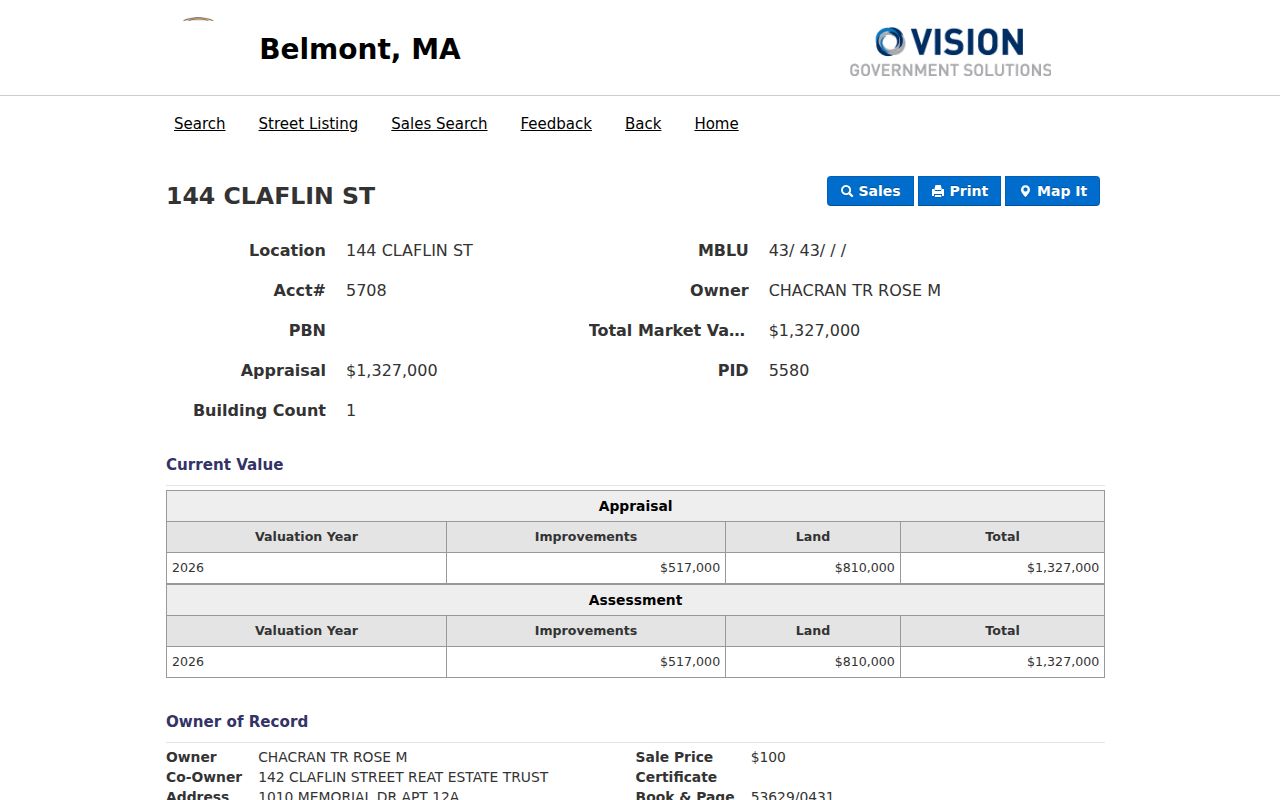
That card is a field example, not proof that every parcel exposes every field. Its separate location and mailing areas are especially important when checking an address by street.
Use the visible search routes as they are labeled in the current interface. The research confirms owner-name, address, and parcel-oriented navigation, while the exact required status of each entry field was not published in the text capture.
| Vision search field | Type | Required | Belmont use |
|---|---|---|---|
| Owner name | Text | Not stated | Find a tax-record owner when the address is not yet known. |
| Address or location | Text | Not stated | Start a Belmont street directory search with the physical parcel address. |
| Parcel identifier | Identifier | Not stated | Use MBLU or account information to distinguish similar addresses or units. |
| Parcel-card fields | Result display | Not applicable | Review owner, mailing, sale, book/page, value, and land or building details together. |
Separate Belmont Situs and Mailing Addresses
“Situs” means the parcel’s physical location. A mailing address is where the assessor sends correspondence for the owner of record. Belmont’s research includes a public-card example with a Belmont situs and a Cambridge mailing address. That is not a conflict in the data. It is a reminder that an owner’s correspondence destination and the place being assessed are separate facts.
This distinction keeps an address search from overstating what it knows. A parcel card can support a statement about tax-record ownership, a mailing destination, or the address assigned to the property. It does not establish who is present at the address on any given day. The card’s sketch may be wrong, and the assessor advises reopening it when that occurs. A value history is likewise an assessment record, not a market conclusion.
- Parcel
- A defined piece of land used for assessment and mapping. Belmont cards can identify it with an MBLU or account number.
- Situs address
- The physical location assigned to the parcel for assessment. It is not automatically the owner’s mailing destination.
- Plat or plan
- A recorded map or plan that can help identify land when a street number is absent or has changed.
- Criss-cross directory
- The street-order part of a historical directory, used to move from an address to an occupant entry for that edition.
Browse Belmont Street Assessment Reports
Belmont’s annual assessment reports are a practical street-browse tool because the PDFs are sorted by address. The official archive supplies reports from FY2011 through FY2025, with current report links added after Department of Revenue approval. Each row can show street number, street, map or parcel information, owner, mailing city/state/ZIP, class, neighborhood, land, total living area, and the current assessment. Reading sequential rows can reveal the tax-record parcel order along a street.
Use the report to make a narrow working list, then verify each parcel in Vision and the Registry. The observed examples include class codes for single-family, condominium, two-family, and three-family parcels, but the full current class options were not exposed in the research. Keep an unfamiliar code as printed rather than assigning it a meaning without an official key.
When a report does not answer the question, the Belmont Assessors are the correction and historical-material route at 617-993-2630. The report is a useful browse surface, but it does not replace the parcel card or a recorded instrument.
Map Belmont Street Parcels
Belmont GIS supplies the spatial layer of a street directory search. Find the target street, use the parcel geometry to understand which lots meet it, and take each parcel back to the assessor card for the record fields. The town confirms the map link, but the research did not verify the current layer names or every select, measure, and neighbor control in the live viewer. Do not promise a particular map layer until it is visible in the current interface.
The official Belmont GIS viewer is the municipal starting point for a map-first parcel check.
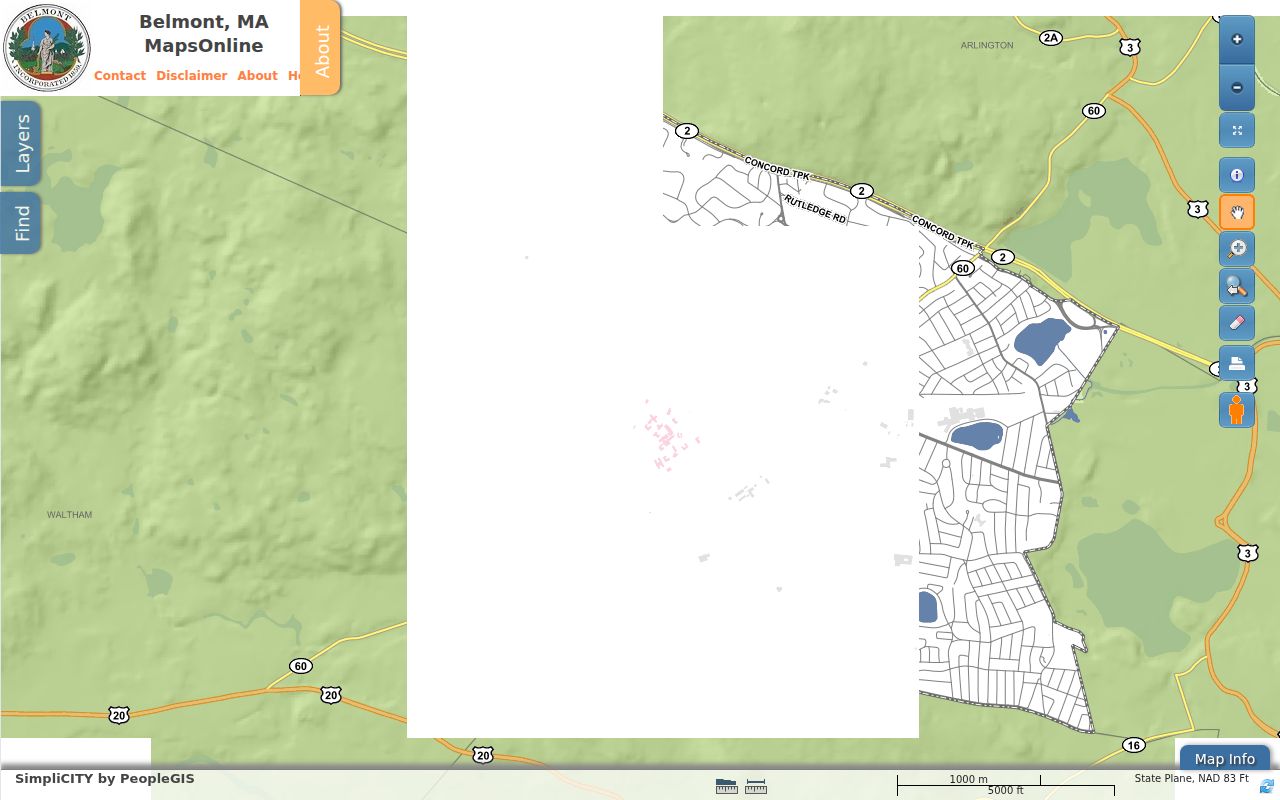
The image documents the official map route, while the parcel card and assessment report provide the fields needed to evaluate a street address.
Historic-area names can help when a directory or newspaper uses an older local description. Belmont Center, Belmont Hill, Belmont Park, Clark Hill, Cushing Square, Payson Park, Snake Hill, Walnut Hill, and Waverley are documented geographic areas. They describe place and development history, not a list of people tied to an address.
Trace Belmont Street Title Records
A street address is only one doorway into a land record. The Middlesex South Registry indexes recorded parties, instruments, dates, book/page references, document numbers, and property information. Start with the assessor’s book/page when available. Open the deed, save the grantor and grantee exactly as indexed, note the date and legal description, then use the prior reference or seller to move backward. A grantor transfers an interest; a grantee receives one.
The Middlesex South recorded-land search includes Recorded Land Name, Document, Book, Property, and Recorded Date modes, alongside registered-land and Land Court modes.
Use the recorded instrument to test the address against its legal description and prior reference, especially when the modern street number does not return a match.
Online searching, viewing, printing, and downloading are currently free. Belmont’s house-history guidance treats 1900 as the safe online cutoff for local work. Earlier books and indexes are at the Middlesex South Registry, 208 Cambridge St. in Cambridge, where recording hours are listed as 8 to 3:45 on weekdays. That counter route is part of a complete address chain, not a last resort to omit.
Note: A deed party demonstrates a recorded title transaction, while an address listing and a voter record answer different questions.
Check Belmont Street Permit Files
Belmont’s online permitting route can add address-based project context. The upgraded portal requires registration, keeps drafts for 90 days, and provides a history summary for a user’s projects or linked permits. It supports building applications and selected work types. A permit may show a project address and applicant or contractor information, but that is evidence about the work record, not a complete account of the people connected to the property.
The town expressly says permit history and inspection records are not online. For those historical files, use the Planning and Building counter at 617-993-2664. This split between an online application route and an office-only archive prevents a Belmont street search from treating a portal result as a full construction history.
Check Belmont Street Voter Requests
Massachusetts keeps two voter-access paths separate. The public statewide status form requires an individual’s first name, last name, date of birth, and five-digit residential ZIP. It returns an individual registration match and is intended for that purpose. Belmont’s Town Clerk and elections office are the documented route for a local voter-list request, which may provide public fields such as name, residence address, party, status, and voter history, subject to production cost and statutory limits.
The official Belmont elections and voting page directs local researchers to voter-history and list-request resources.
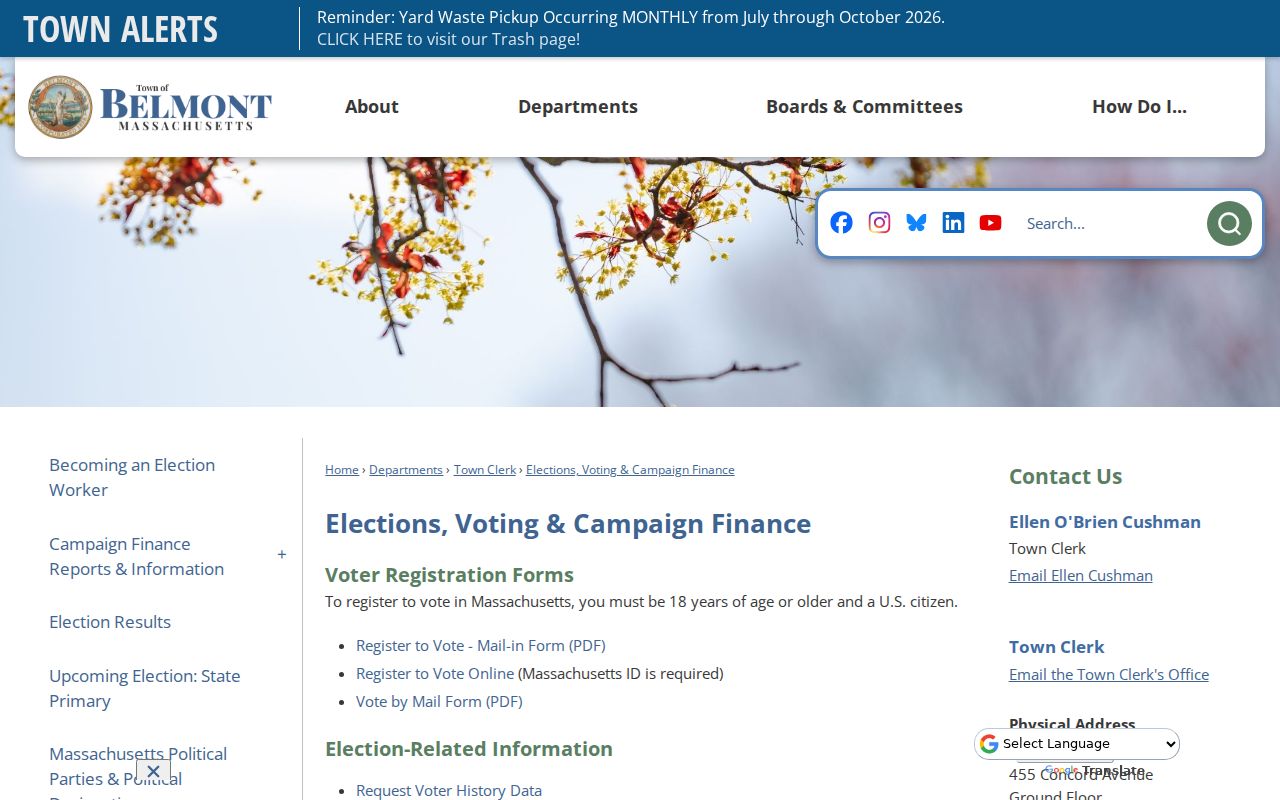
The public list does not include phone, email, confidential-voter data, or other protected fields. A nearby registration record is not proof of every person connected to a street address.
Use Belmont Street Historical Lists
Historical street work changes from parcel fields to dated printed evidence. The 1869 regional directory contains Belmont streets and a Belmont Directory section, and later regional runs include street or house lists. Belmont resident lists span 1911 to 2009 with gaps. The Underwood Local History Room also directs researchers to newspapers, yearbooks, an obituary index, oral histories, and local material that can clarify an address across time.
Start in the reverse or criss-cross portion when a street and number are known. Then read the surname entry for the address shorthand and other printed details. Compare the edition with a resident list, a census year, and a deed date before connecting an occupant to ownership. The historical shelf is described in depth in the Belmont city directory collections; use it for the volume-by-volume holdings rather than assuming every year is online.
Belmont has no verified townwide renumbering or renamed-street table in the research. When an old number fails, bridge it with a legal description, cross streets, maps, lot size, owner surname, and nearby parcels. Do not silently convert an old address to a modern number.
Belmont Street Directory Record Coverage
The following address-keyed records form the usable Belmont street directory chain. They overlap, but none is a substitute for the others. A parcel row can narrow an address, the GIS can establish spatial context, and the Registry can document title. The remaining sources are best used as dated supporting evidence.
| Address record | Belmont keeper | What a street search shows | Access channel |
|---|---|---|---|
| Vision parcel card | Belmont Assessors | Situs, tax-record owner, mailing field, value, sale history, and book/page | Free web portal; assessor correction route |
| Annual assessment report | Belmont Assessors | Address-sorted rows, owner, parcel fields, class, neighborhood, and assessment | Official FY2011-FY2025 PDFs |
| GIS parcel map | Belmont GIS | Parcel geometry, street context, and available municipal layers | Official dynamic viewer |
| Recorded deed | Middlesex South Registry | Parties, dates, legal description, book/page, and image | Free online index and images; Cambridge books for earlier work |
| Permit or inspection file | Planning and Building | Project address, permit type, and selected project documents | Online workflow; in-person archive for history and inspections |
| Regional directory or resident list | Library, Town Clerk, and historical collections | Dated address and occupant evidence | Digitized sources, microfilm, staff help, appointment, or physical holdings |
The Town Clerk and election office are another documented channel when a lawful local voter-list request is appropriate. The statewide form is an individual checker, and protected records remain withheld. A dated, narrow request is more reliable than assuming a street can be searched as a live public roster.
Request Belmont Street Records
When the web record ends, describe the address, date range, record type, and format needed to the custodian. Belmont accepts public-record requests online through NextRequest, as well as by mail, email, fax, or in person. The town states that the Records Access Officer generally responds within 10 business days, subject to exemptions and appeal rights in the response. A reasonably described request is more useful than an open-ended demand for names at an address.
Send deed questions to the Registry, parcel corrections or assessment history to the Assessors, historical permit and inspection questions to Planning and Building, and older directory questions to library or Historical Society staff. For pre-1900 land work, make the Cambridge physical-book visit part of the request plan. Each office has a different collection and should be asked for the record it actually holds.
Respect Belmont Street Directory Limits
A Belmont street directory can identify public property, title, and dated directory evidence. It cannot establish every person connected to a parcel. The statewide voter lookup requires individual information and is not a street browse. Confidential voters are withheld from ordinary public lists, and the Massachusetts Address Confidentiality Program can protect qualifying addresses. DMV information and utility-account information are not public street-directory sources.
Use discrepancies as a reason to verify, not as a reason to guess. A current tax owner, a historical directory occupant, and a recorded seller may all be different names because they refer to different dates and roles. Massachusetts Public Records Law access does not erase court impoundment, voter confidentiality, or other statutory protections.
Lawful use. Belmont address records are for personal, lawful research. Do not use public details to stalk, harass, intimidate, threaten, or harm anyone; Massachusetts law provides penalties and civil protections for that conduct.