
Belmont Previous Residents by Era
Start with the source that fits the time period, not with a broad name search. Belmont property research has one trail for recorded ownership and another for household presence. The current parcel card and deed trail are best for title. Regional directories, resident lists, newspapers, and the federal census help answer who lived there before. Each item should be dated because it records a different event: a deed records a transaction, a directory records an entry, and a census records one enumerator's visit.
| Belmont source | Period covered | Custody | Address evidence |
|---|---|---|---|
| Middlesex South online deeds | Local guide: 1900 forward | MassLandRecords | Recorded parties, deed type, date, book/page, and image |
| Registry books and indices | Earlier material, including nineteenth-century records | Middlesex South, Cambridge | Older grantor/grantee chain and legal descriptions |
| Regional directories | 1869-70 through 1969, with gaps | State Library, library, archives, and digitized volumes | Occupant, work, household shorthand, and street lists |
| Belmont resident lists | 1911-2009, with missing years | Town Clerk, library, and Internet Archive | Annual resident or census-style evidence |
| Federal census | 1790-1950 | NARA and partner access | Household and address context at enumeration |
| Sanborn maps | 1905, 1910, 1915, 1922, plus survey-cited later sheets | Library of Congress, State Library, and local survey | Building footprint, use, and street context |
Begin with a current address when the house is known. Begin with a surname and a directory or resident list when the household is known but the number is not. The physical registry becomes essential if the chain reaches beyond the web index.
Belmont Book and Page First
The Belmont Historical Society house-history guide gives the practical start: take the current deed or tax bill, copy its book and page, and open the recorded instrument. The assessor card helps locate the tax-record owner, parcel facts, sale reference, and mailing destination. Its mailing destination is not the same thing as the Belmont property location. A trust, estate, or out-of-town owner can appear on a card, so retain the name exactly as indexed.
The deed should supply the names of the parties, execution and recording dates, legal description, and a prior reference when present. Record those facts in a simple timeline. A street number alone can disappear from an older deed, while the legal description can connect the parcel across a change in street wording or numbering.
Note: A tax assessment establishes the town's owner record and value context, not a complete list of people who occupied the address.
Belmont Previous Residents Through Deeds
The deed chain is the backbone for past owners. The registry's recorded-land tools offer name, document, book, property, date, and unindexed-property search modes, with parallel registered-land modes. When a document has a book and page from the assessor card, use that direct reference first. Read the instrument rather than relying on a search snippet. It may explain a transfer that looks unusual on a parcel card, such as an estate or trust transaction.
- Open the current Belmont parcel card and copy the owner name, book/page, sale date, and parcel or legal-description clues.
- Find that instrument in Middlesex South MassLandRecords and note its grantor, grantee, and any prior reference.
- Search the seller as a grantee to find that seller's earlier purchase, then repeat the same reading and note-taking process.
- Compare names, dates, parcel wording, and adjacent owners before joining two records with similar surnames.
- When the trail moves before the local guide's online boundary, request or inspect the Cambridge registry's physical books instead of treating a web miss as a dead end.
- Grantor and grantee
- The grantor transfers an interest; the grantee receives it. The roles can reverse at the next transaction.
- Chain of title
- A dated sequence of recorded transfers for the same parcel or legal description.
- Legal description
- The land description carried in recorded documents. It is often more durable than a street number.
- Criss-cross directory
- A directory organized by street and number so an address can lead to an occupant entry.
Belmont's 1900 Deed Boundary
Online access is convenient, but it is not the full Belmont land record. The local house-history guide describes the online Middlesex South route as reaching back to 1900 and directs earlier work to the Registry of Deeds at 208 Cambridge Street in Cambridge. Registry folders include older grantor-index material, yet the 1900 guidance is the safer cutoff for an address investigation. Keep the distinction clear when documenting previous residents from a nineteenth-century house.
This is a useful records comparison. A web index can point quickly to a recorded document and its image for the modern period. The counter route gives access to the older books and indexes that the online search cannot promise. The same address may therefore have a complete-looking recent chain and a real earlier gap. The gap usually calls for a registry visit or a specific records request, not a guess about the owner.
Belmont Past Residents Beyond Title
Recorded ownership and household presence are different facts. To learn who lived at an address, use a regional reverse directory or street list near the deed date, then check the surname portion for work, relationship, or address shorthand. Belmont's directory runs were often regional Arlington and Belmont volumes, and later editions include street and house lists. The collections themselves, including their publishers and shelf locations, are detailed on the Belmont city directory page.
Pair the directory evidence with a resident list and the federal census closest to the decade. A directory occupant might be a boarder or might use a work address. A census identifies people counted in a household on one date. A deed identifies recorded title. Keep conflicting evidence in the timeline rather than forcing one source to answer every question.
- Choose a directory or resident-list year near the transfer date.
- Read the address or street list, then check the surname entry and its abbreviations.
- Compare that result with the nearest available census and retain both dates.
- Use a deed, obituary, or probate file only to test a specific relationship or change, not to replace the household sources.
Belmont Sanborn Maps Date Change
Maps can make a past-resident trail more precise when a house changed use, expanded, or had an uncertain number. Belmont Sanborn coverage includes 1905, 1910, 1915, and 1922, while the town survey also cites 1931 and 1949. A sheet can show a building footprint, material, use, and the neighboring street pattern. It does not list a household, but it can show whether the address context in a directory makes sense.
See the Historical Society's house-history guide before moving from a modern parcel card to older maps and books.
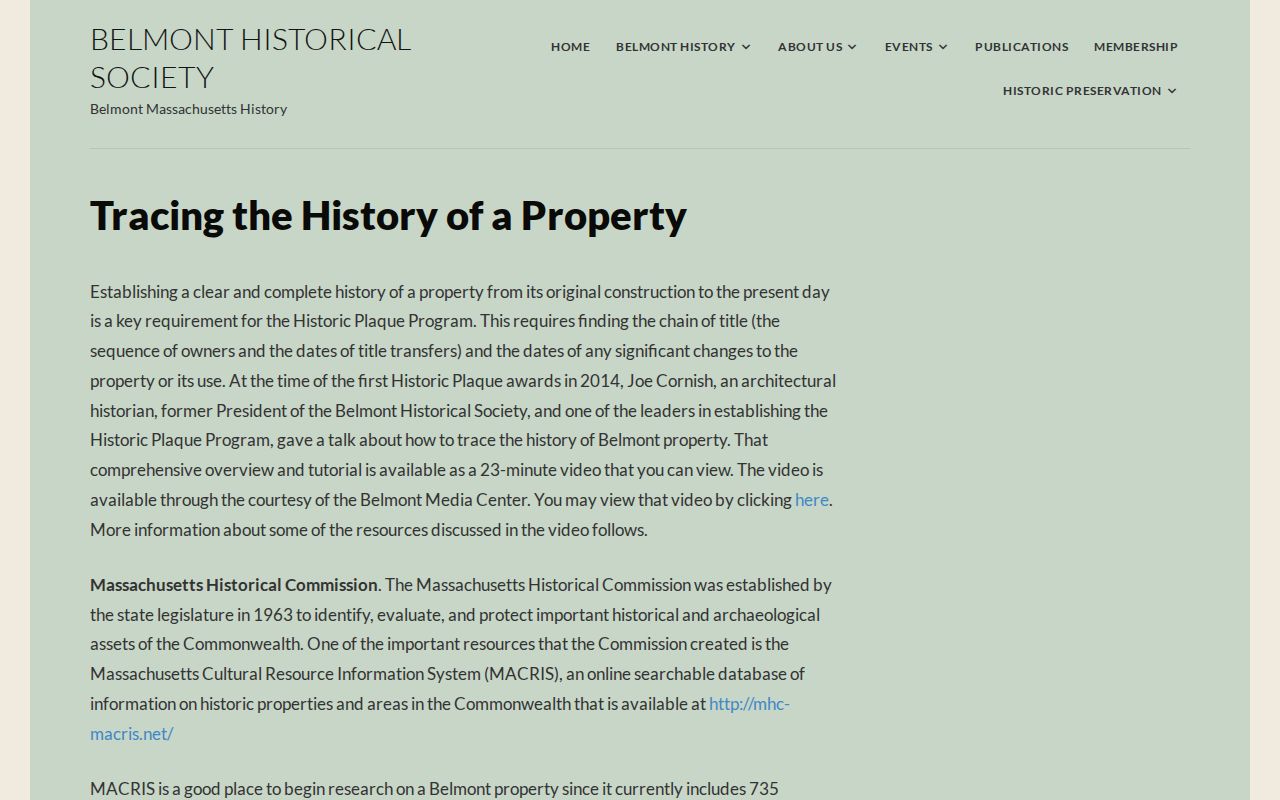
The guide ties the map, deed, and local-collection steps together, which helps separate a building's physical history from the names attached to it at different times.
Belmont Resident Lists and Obituary Clues
Belmont resident lists cover 1911 through 2009, with missing years available by appointment when fragile material survives. The Belmont Public Library adds local newspapers, yearbooks, oral histories, and the Belmont Herald Obituary Index. The Herald index is split into Known as and Former/Maiden files, which is a valuable local check when a surname changes. A full obituary still needs to be read in the digitized paper or on microfilm.
These sources can close a trail after a person leaves a house. A notice may give a family relationship, civic group, or former address; a cemetery record or probate docket may identify the later estate connection. None should be used as a shortcut to expose protected information about a living person. Search the source image when possible because newspaper OCR can misread names and addresses.
Belmont Old Addresses Need Proof
No verified Belmont-wide street-renumbering table or official continuity schedule was located. That absence matters. Do not silently convert an old number to a modern one because the street name looks familiar. Instead, connect records through cross streets, lot size, legal description, owner surname, nearby parcels, and a Sanborn sheet. The historical district names, such as Belmont Center, Waverley, Belmont Hill, and Cushing Square, can also help interpret directory and newspaper language.
Permit records add another address clue, but they have their own limit. Belmont's online permitting system supports current applications and selected documents, while historical permit and inspection files are not online and require an in-person Planning and Building visit. An applicant or contractor named on a permit is not automatically an owner or resident. Treat it as project evidence and confirm the role elsewhere.
Note: Preserve an uncertain address as written in the source until several independent parcel or map clues support the match.
Belmont Previous Residents at Trail Ends
Probate and obituary material can help when a title chain ends in an estate or a household disappears from the resident trail. Middlesex Probate and Family Court in South-Woburn may show a decedent, fiduciary, or interested parties in public portions of a case. The registry and court keep restricted material separate, so a docket entry is not a certified record and adoption, family, and account details can remain confidential.
Belmont's cemetery and library genealogy routes also provide a focused way to confirm a death or burial connection. Written genealogy requests, local records, and the obituary index are better suited to family-history questions than an attempt to reconstruct a current household. Keep the record type and date in the research log so the next source can test it.
Belmont Previous Residents and Privacy
Previous-resident research is strongest when it stays tied to a house-history, family-history, estate, or archival question. Public files do not create a complete roster of every person at a property. Confidential voters, protected addresses, DMV data, utility accounts, and many family-court records are not ordinary lookup material. Massachusetts also provides address-confidentiality and confidential-voter protections for qualifying people.
Lawful use. Use Belmont property and historical records for legitimate personal research. Do not use a past address or a public record to stalk, harass, intimidate, or harm anyone.