
Belmont Neighbors Around One Block
A block search works best when each source is allowed to answer its own question. Belmont GIS supplies the parcel pattern. The assessment report identifies the town's tax-record owner and mailing destination. The registry shows recorded parties and legal descriptions. Older reverse directories can place an occupant at a street number. None of those sources proves every person in a household, so do not turn a chain of public records into a claim about all of your Belmont neighbors.
| Block source | What it shows about nearby parcels | Access route |
|---|---|---|
| Belmont GIS | Parcel polygons, streets, and available map context | Municipal GIS viewer |
| Annual assessment report | Consecutive addresses, tax-record owner, mailing city/state/ZIP, and parcel fields | Official address-sorted reports |
| Vision parcel card | Location, owner, co-owner or trust, mailing address, MBLU, sale history, and assessment facts | Free assessor search |
| Middlesex South Registry | Recorded owners, sellers, document dates, book/page, and legal description | MassLandRecords |
| Local voter list | Permitted registered-voter fields at a requested date | Request from Belmont's election office |
| Regional reverse directory | Historical address-to-occupant entries and street lists | Library and historical collections |
Tax ownership, recorded title, and physical residence are separate facts. An owner may use another mailing address, a parcel may be held in trust, and an occupant may not be reflected in a land record.
Belmont Neighbor GIS Limit
The official Belmont GIS link is the right spatial starting point. Locate the street, zoom to the target parcel, and use the parcel shape to identify the immediately adjoining parcels. The research confirmed the municipal viewer but did not confirm its current click, buffer, measuring, or layer controls in a text-only inspection. That gap should remain visible. Do not promise layers such as zoning or flood maps without checking the live interface.
The useful result is a short, bounded list of adjacent parcel identifiers, not a radius of names. Save the street and parcel context, then open each public assessor card separately. This method prevents similar street names, condominium units, and close-but-not-adjacent lots from being merged into one neighbor search.
Note: A parcel boundary establishes land context. It does not identify the people currently inside a building.
Mapping Belmont Neighbors Parcel by Parcel
The adjacent-parcel method moves from a known address to a small set of public property records. It is deliberately narrower than a named-street search. Record the target parcel first, then only the parcels that share its boundary or sit directly across the street. Follow the same process for each one, and keep the source date because the assessor and registry update on different schedules.
- Find the target address in the Belmont GIS viewer and note the parcel boundaries visible around it.
- Open the Vision assessor card for the target and each adjoining parcel, keeping the location, MBLU, owner, and mailing address distinct.
- Use the listed book/page or legal-description clues to check a recorded instrument when title history is relevant.
- Read annual assessment-report rows in address order when the question concerns the immediate street segment.
- For a longer street-by-street record trail, use the Belmont street directory rather than expanding a block search without a boundary.
The parcel card is a tax record. It can show an owner and a correspondence address, but the records do not supply a universal occupant field or a complete household list.
Belmont Neighbor Assessment Reports
Belmont's annual assessment reports are a particularly good block tool because they are address-sorted PDFs. The official archive runs from FY2011 through FY2025, with current reports added after Department of Revenue approval. A row can include street number and name, map/parcel/suffix/unit, owner, mailing city/state/ZIP, class, neighborhood, land, total living area, and assessment. Reading several consecutive rows gives a more reliable view of the public tax record than assuming one map label describes an entire block.
The reports should be read with care. The recorded class examples include single-family, condominium, two-family, and three-family codes, but the captured sources do not establish every current class option. A mailing ZIP is also not the parcel's location. These distinctions matter when neighbors share a street but have different ownership or correspondence arrangements.
Belmont Voter Records Are Not a Block Search
Massachusetts has an individual voter-status form, not an unrestricted web browse for everyone on a street. The form requires first name, last name, birth month, day, year, and a five-digit residential ZIP, plus its agreement checkbox. Its result is a registration match. Belmont's election office can provide a permitted local list through a request, but confidential voters and protected information are withheld and production costs may apply.
A public local list can include fields such as name, residence address, party, date of birth, active or inactive status, voter ID, registration date, and participation history. Phone, email, veteran status, permanent absentee information, confidential-voter data, and protected minor data are not ordinary public fields. The statewide file is not a general public download. A voter entry should never be used to infer every resident at a nearby address.
Belmont Neighbor Lists Need Dates
A voter list is a snapshot with maintenance rules, not a permanent map of Belmont neighbors. The town's 2023 annual report recorded 18,218 registered voters at the end of that year, including 1,182 new voters and 1,083 removals during the year. The annual election had 17,719 registered voters and 6,459 votes. Those numbers give scale to the local system, but they do not replace a dated request for the particular record needed.
Annual census responses help maintain voter records. Returned mail, address-confirmation notices, or a census nonresponse can affect active or inactive status, and an inactive voter may need to affirm continued residence at the polls. Record the date and format of any list received from the Town Clerk. A past public entry can be a useful historical lead, but it should not be treated as current proof of residence.
Belmont Historic Areas Shape Searches
Belmont's named areas can help place an older address in its neighborhood context. The town identifies Belmont Center, Belmont Hill, Belmont Park, Clark Hill, Cushing Square, Payson Park, Snake Hill, Walnut Hill, and Waverley as distinctive historic or geographic areas. These names are useful for map, newspaper, directory, and historical-society searches because older material may use a square, hill, or station-area description instead of a modern label.
They are not an association roster. The town did not yield a verified neighborhood-association or HOA directory, so an area name must not be presented as membership evidence. Use it to locate a block in historical context, then return to a parcel, directory, or documented civic source for the next record.
Belmont Community Sources for Neighbors
Public community resources can add local context without pretending to list the block. The strongest verified civic layer is Belmont Citizens Forum, which publishes civic news and a bimonthly newsletter. The library and Historical Society provide newspapers, oral histories, maps, photographs, and local-history help. Their collections may explain a building, organization, or neighborhood event, but they are not present-day household directories.
| Belmont Citizens Forum | Civic-news and newsletter source; public contact is PO Box 609, Belmont. |
|---|---|
| Belmont Public Library | Underwood Local History resources for resident lists, newspapers, yearbooks, and oral histories. |
| Belmont Historical Society | Claflin Room collections for maps, archives, photographs, and Belmont-related material. |
| Neighborhood associations | No verified official Belmont association or HOA directory was located in the research. |
The absence of a published member roster is important. A civic organization or historic-area name can be a research lead, not proof that a particular neighbor belongs to it.
See Belmont Citizens Forum's public page for the civic-news layer used here.
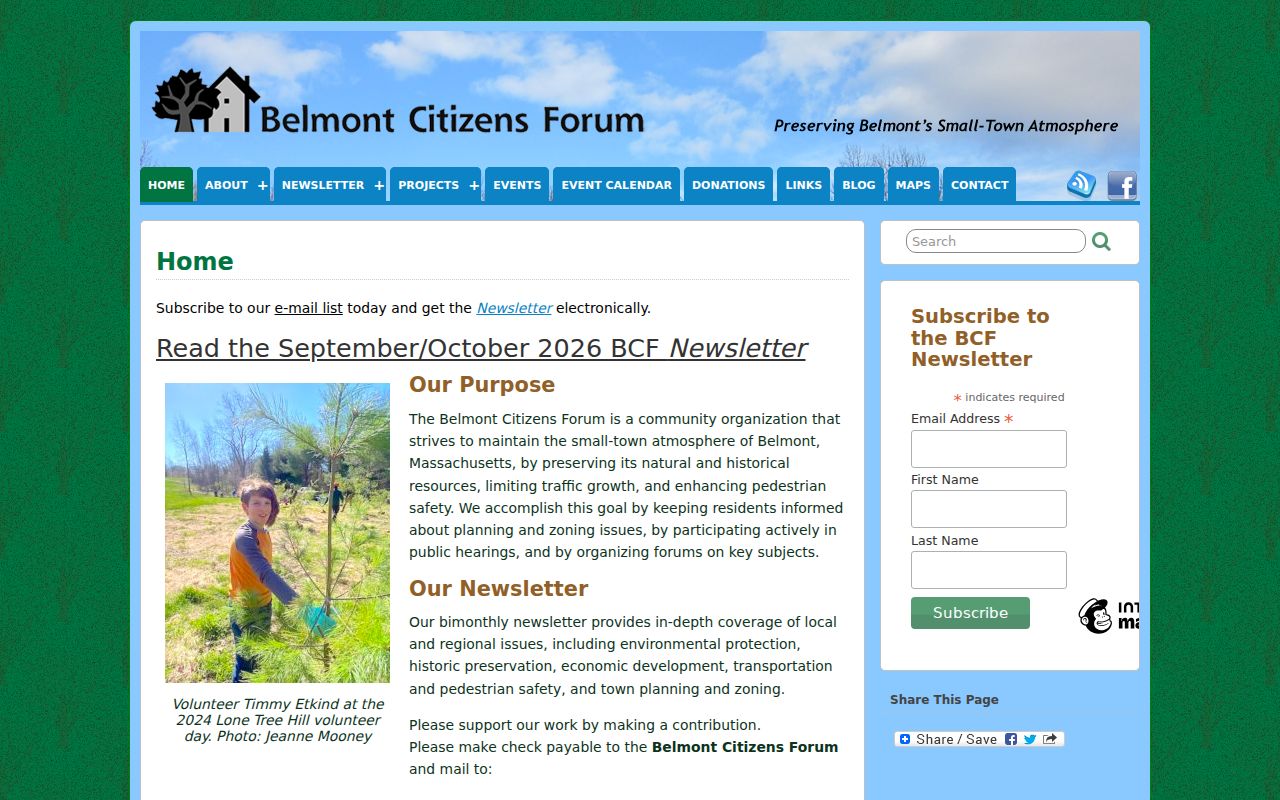
The page is useful for community context and public contact information, while the parcel and registry records remain the sources for property facts.
Belmont Neighbors: Official Records Compared
For a block question, official records have a clear advantage: they identify the custodian, date, and type of fact. The assessor's card is a current tax-record snapshot. The registry is the recorded-title source. A local voter list is governed by election law and its field limits. Commercial compilation services can combine filings and purchased data, but their addresses and identity matches can be stale or mixed, and their opt-out procedures vary.
| Source type | Best use | Limit to remember |
|---|---|---|
| Official parcel and registry records | Verify a parcel, tax-record owner, or recorded party | Do not prove every occupant or a current household |
| Local voter-list request | Request permitted voter fields through the custodian | Protected fields and confidential voters are withheld |
| Commercial compiled data | Use only as an unverified lead to a custodian record | Matches, dates, and coverage can be uncertain |
Belmont Neighbors Have Privacy Limits
Public records are not permission to assemble a dossier on nearby people. Massachusetts Address Confidentiality Program participants and confidential voters are protected from ordinary public-list disclosure. Court files can be sealed or impounded, while DMV information, utility accounts, and many family details are not public block data. A public parcel card should never be used to infer protected information.
Massachusetts criminal-harassment and stalking laws prohibit patterns of conduct that cause serious alarm, distress, or fear. The public information in a voter, assessor, or registry record does not authorize repeated contact, intimidation, threats, or publication of a protected address.
Lawful use. Use Belmont neighbor records for legitimate personal, civic, or historical research. Do not use them to stalk, harass, intimidate, or harm any person.